
MIDI stands for Musical Instrument Digital Interface. It is a technical standard and communication protocol that allows electronic musical instruments, computers, and other hardware to connect, communicate, and share data, such as note, pitch, velocity, and control signals.
What is MIDI 2.0
MIDI 2.0 is a major update to the 1983 MIDI standard that enables two-way, bidirectional communication between musical devices and software. It enhances musicality with much higher resolution, auto-configuration, and improved timing, while maintaining full backward compatibility with MIDI 1.0 gear.
Key Features
- Piano, Drum, DAW MIDI Transport/ Location , DAW Macro Control Profiles
- MIDI-CI Helper project. Developed by the plugin format companies (Apple, Avid, Bitwig, and Steinberg), this will allow MIDI 2.0 hardware devices to communicate with plugins via Open Source Software
- Standard MIDI 2.0 File MIDI Container File (SMF2)Specification
- MIDI 2.0 transports including Bluetooth, CAN, and WebMIDI
- Multiple Property Exchange Specifications
The State of MIDI 2.0: High-Resolution Performance and the Rise of Profiles
MIDI 2.0 DAW Control Profiles
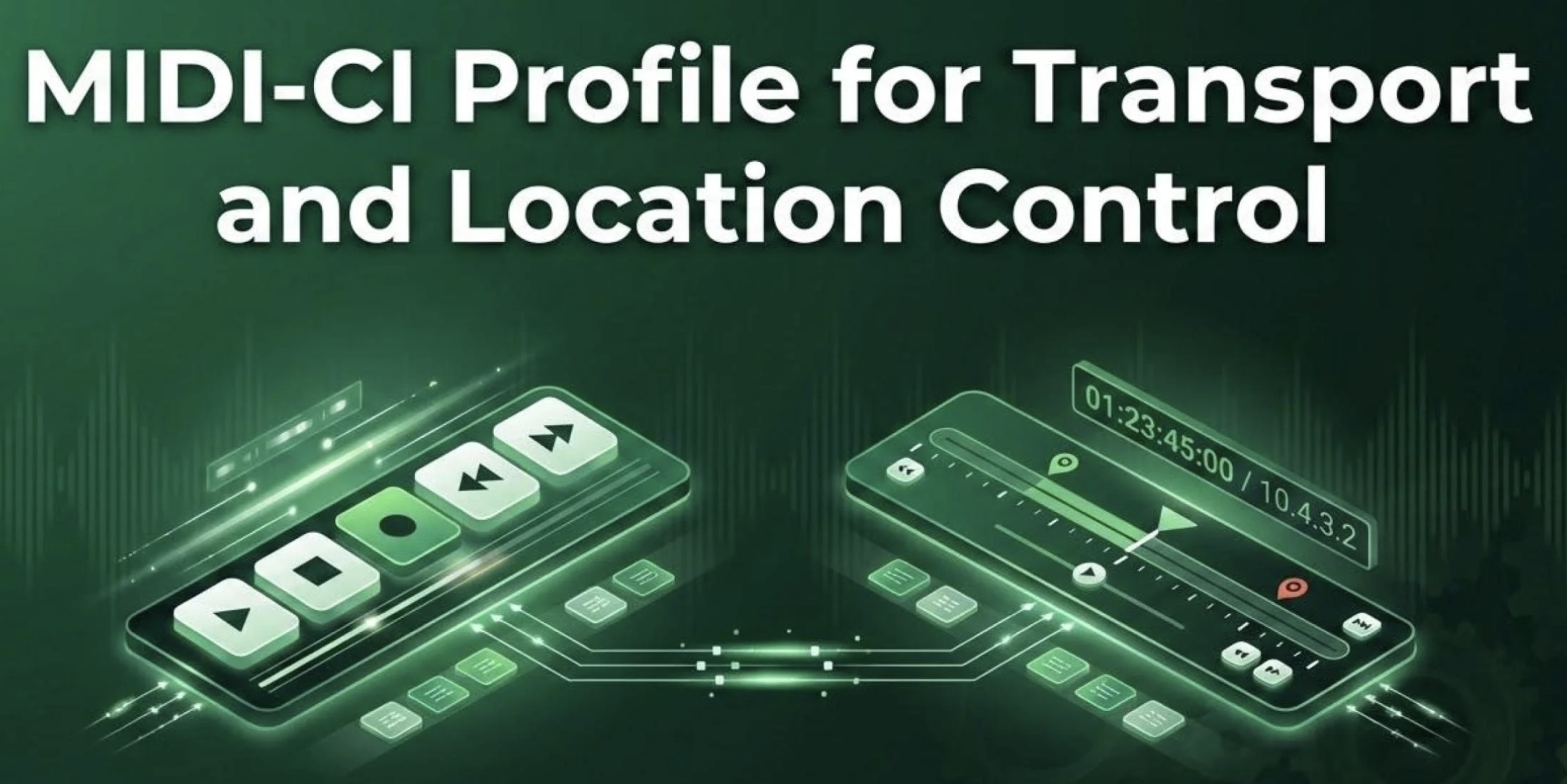
The MIDI Association is working on a modular set of MIDI 2.0 DAW Control Profiles intended to eventually replace Mackie Control with a unified industry standard for all hardware and software.
The modular approach was taken because of the wide variety of capabilities of DAW controllers from simple start, stop and record buttons to elaborate devices with multiple displays.
The first Profile will be a Function Block Transport Control and Location Profile that defines Transport Control, Record Arm, Cycle Markers, and Punch In and Out Points
The second planned Profile is a Single Channel Dynamic Control Profile. Dynamic Controls are a set of controls that affect remote parameters of a Device. It is most often a plugin or tone generator. The set of parameters that are affected may change between sound engines or even between patches and are typically the parameters that represent the best/common ways to adjust the sound. This specification is intended to promote capability between products that either use a set of common physical controls to manage different destinations or change the set of destinations depending on focus.
The third planned Profile is a Function Block Mixing profile.
https://midi.org/daw-control-profiles-update-at-namm-2026
The Piano Profile
The Piano Profile standardizes the velocity and pedal curves and the registered controllers used to control a piano’s performance via MIDI. The goal of the Piano profile is to improve the interoperability between different manufacturers whether they make digital pianos, keyboard controllers, software synthesizers or acoustic pianos driven by MIDI
https://midi.org/the-piano-profile-at-namm-2026
The Default Drum Map Profile
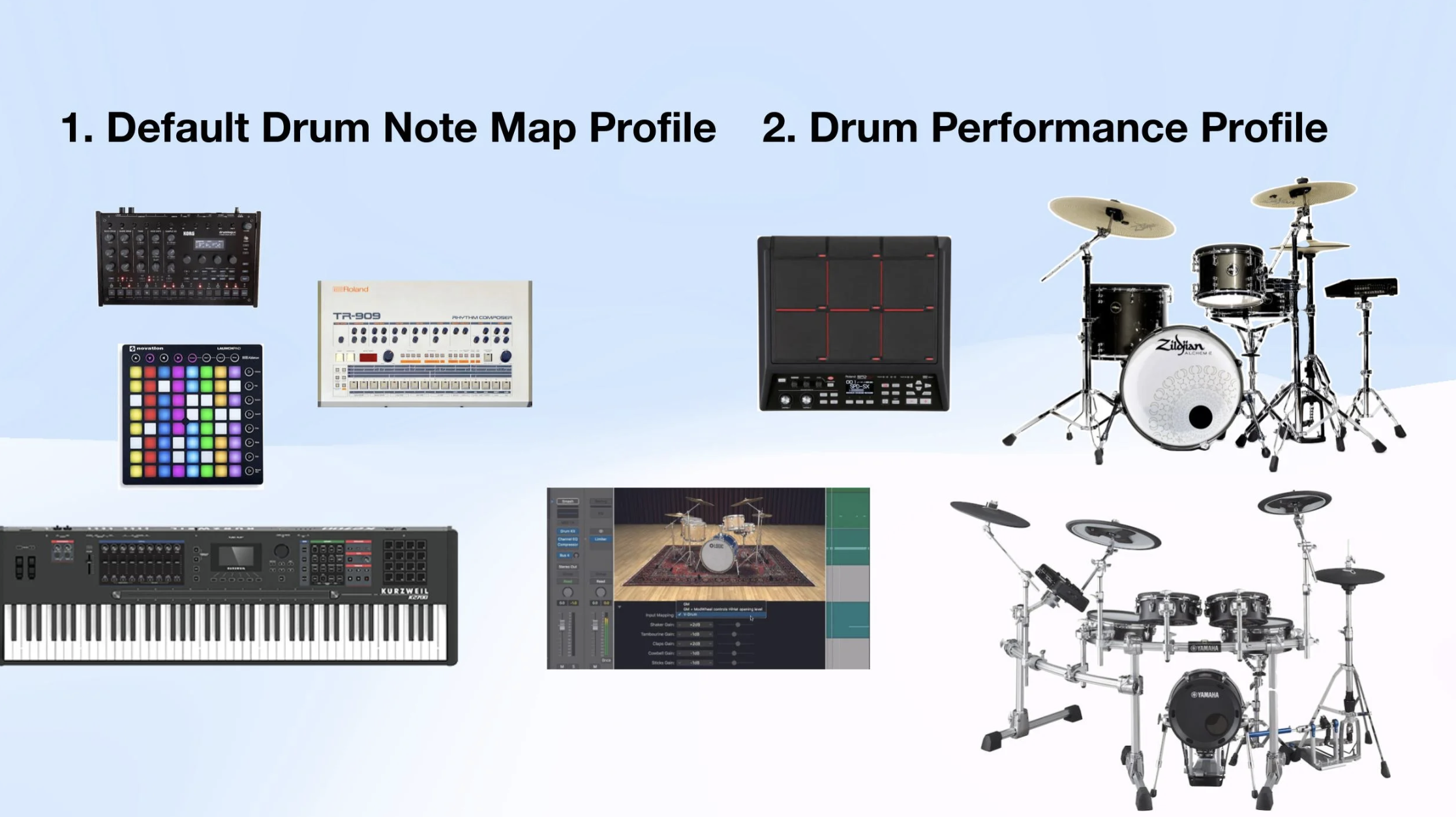
The Default Drum Map Profile defines a MIDI-CI Profile for a default mapping of specific drums to specific Note Numbers. The note map used in this Profile was established by many products in the 1980s as a commonly used set of note assignments for drum sounds and that was later standardized in General MIDI.
Many drum machines, grooveboxes, keyboard workstations, portable keyboards, digital pianos, and software synthesizers (many of which do NOT support the full GM specification) have drum kits that utilize this drum kit mapping because of the vast quantity of MIDI data available that will play properly with these drum maps.
Electronic Drums are one of the most successful categories of MIDI instruments.
Most electronic drums from different manufacturers share a common set of features (standard MIDI messages including velocity, pan,etc.) as well as more drum specific features (choking of cymbals, positional sensing of cymbals and drums, etc). However, the MIDI messages used to control these features have not been standardized and mainly rely on manufacturer specific SysEx. A MIDI-CI Profile would define far greater interoperability, unifying the industry behind a common set of MIDI messages.
https://midi.org/midi-2-0-drum-profiles
Plugin Formats Open Source Support for MIDI 2.0
The MIDI Association member companies that develop plugin formats – Apple (Audio Units), Avid (AAX), Bitwig (CLAP) and Steinberg (VST) are working together to develop open-source software that will enable plugin developers to quickly and easily interface with external MIDI gear without the need for any in depth knowledge of MIDI 2.0 or MIDI-CI. Another MIDI Association member supporting this effort is JUCE – the most widely used framework for audio application and plug-in development.
The MIDI Association DAW working group is creating open source software that will look at MIDI 2.0 messages from external devices, extract the information the plugin needs to support Profiles like the Orchestral Articulation, MPE and Piano profiles and translate those MIDI messages into the native plug formats that plugins already understand.
By utilizing this open source software, plugin companies can start supporting MIDI 2.0 external devices with minimal development costs.
https://midi.org/plugin-formats-open-source-support-for-midi-2-0
SMF2 Container Format For Data Exchange
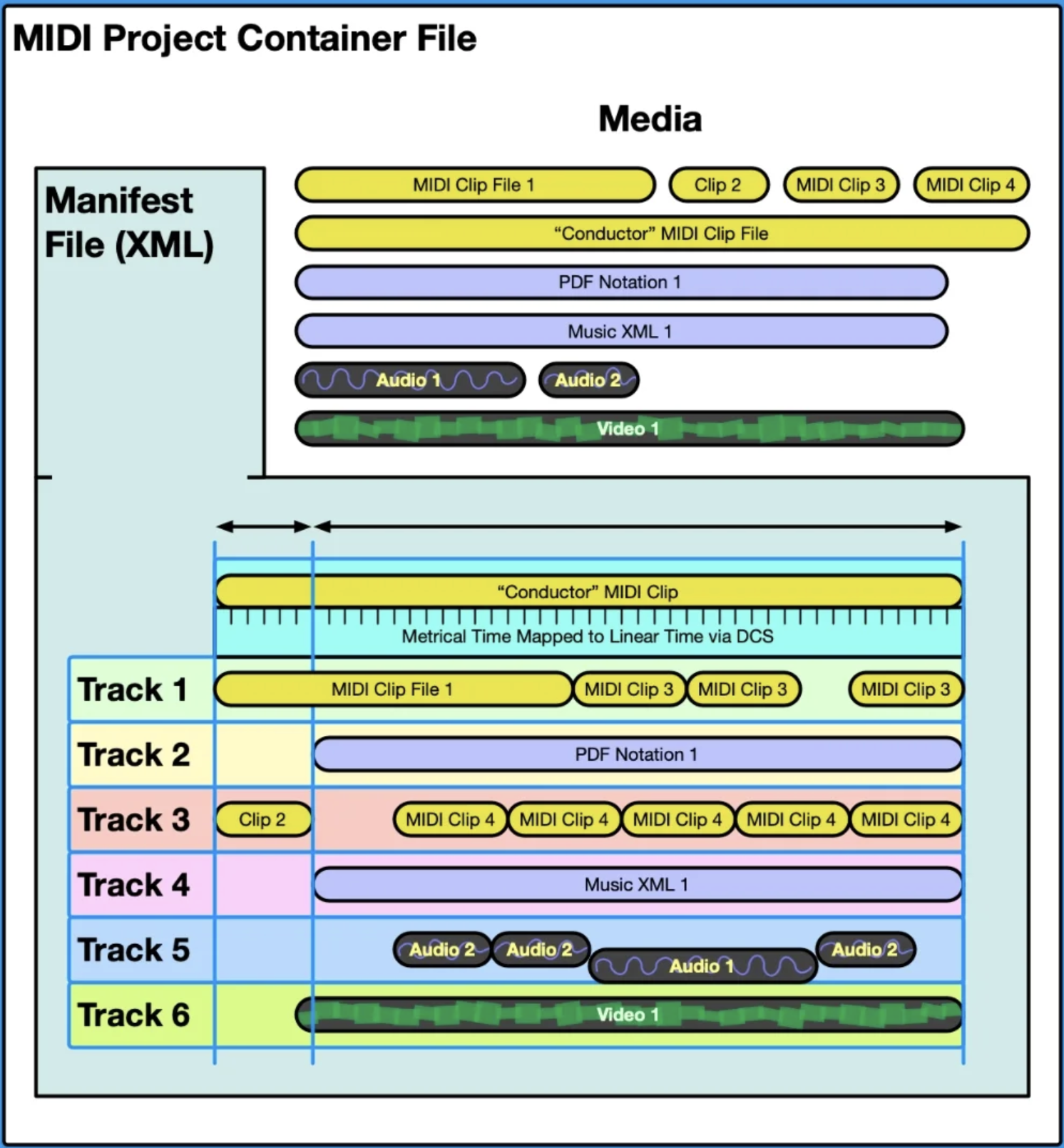
The SMF 2 container format is intended to deliver multiple tracks of MIDI data and other tracks of media including Audio, Video and Notation on a single timeline.
Media types supported in the SMF2 Container Format
● MIDI Clip Files (for MIDI 1.0 and MIDI 2.0)
● Musical Notation (MusicXML [W3C01] or PDF [ISO01])
● Audio Files
● Video Files
● Lyrics: may be in MIDI Clip Files and/or in Musical Notation files.
● Metadata – XML and MIDI Message
The MIDI Project Container File format has two main use cases.
● Distribution/publishing of content that includes both MIDI and any of the file types listed above
● Data exchange between software and hardware applications that include both MIDI and any of the file types listed above. For example, rich media data exchange between two DAWs from two different companies that include MIDI, Audio, Video and notation on a timeline.
This is a very useful container format as people with different DAWs, different studio setups (audio interfaces and monitoring systems) and plugins can still collaborate on projects together.
https://midi.org/daw-control-profiles-update-at-namm-2026
MIDI 2.0 Transports - Network, BLE, Web MIDI and Transport Remote Management
https://midi.org/new-midi-2-0-transports-ble-web-midi-and-transport-remote-management
https://midi.org/network-midi-2-0-udp-overview
MIDI 2.0 Multiple Property Exchange Specifications
MIDI 2.0 Means Two-way MIDI Conversations
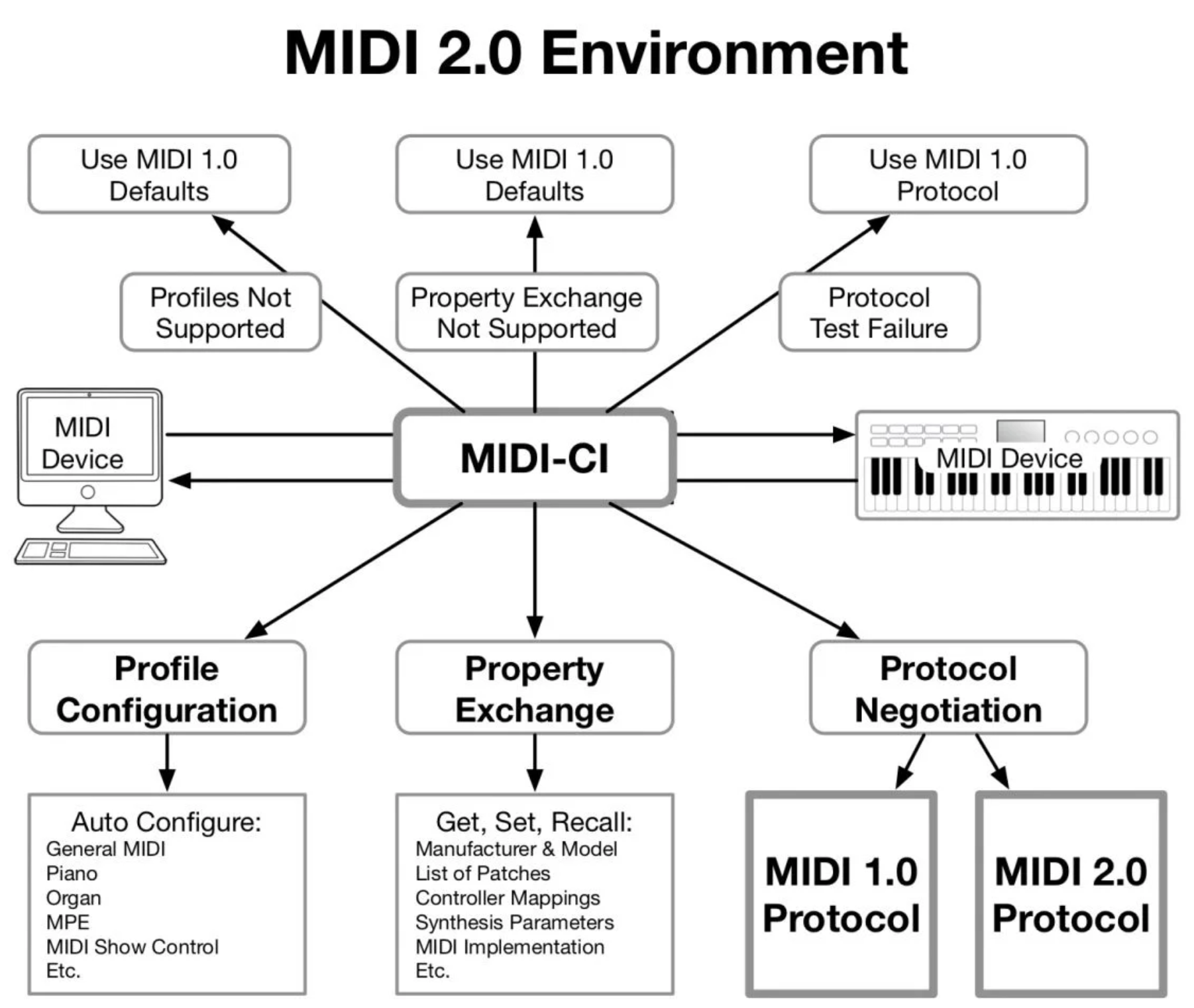
MIDI 1.0 messages went in one direction: from a transmitter to a receiver. MIDI 2.0 is bi-directional and changes MIDI from a monologue to a dialog. For example, with the new MIDI-CI (Capability Inquiry) messages, MIDI 2.0 devices can talk to each other, and auto-configure themselves to work together. They can also exchange information on functionality, which is key to backward compatibility—MIDI 2.0 gear can find out if a device doesn’t support MIDI 2.0, and then simply communicate using MIDI 1.0.
Higher Resolution, More Controllers and Better Timing
To deliver an unprecedented level of nuanced musical and artistic expressiveness, MIDI 2.0 re-imagines the role of performance controllers, the aspect of MIDI that translates human performance gestures to data computers can understand. Controllers are now easier to use, and there are more of them: over 32,000 controllers, including controls for individual notes. Enhanced, 32-bit resolution gives controls a smooth, continuous, “analog” feel. New Note-On options were added for articulation control and precise note pitch. In addition, dynamic response (velocity) has been upgraded. What’s more, major timing improvements in MIDI 2.0 can apply to MIDI 1.0 devices—in fact, some MIDI 1.0 gear can even “retrofit” certain MIDI 2.0 features.
Profile Configuration
MIDI gear can now have Profiles that can dynamically configure a device for a particular use case. If a control surface queries a device with a “mixer” Profile, then the controls will map to faders, panpots, and other mixer parameters. But with a “drawbar organ” Profile, that same control surface can map its controls automatically to virtual drawbars and other keyboard parameters—or map to dimmers if the profile is a lighting controller. This saves setup time, improves workflow, and eliminates tedious manual programming.
Property Exchange
While Profiles set up an entire device, Property Exchange messages provide specific, detailed information sharing. These messages can discover, retrieve, and set many properties like preset names, individual parameter settings, and unique functionalities—basically, everything a MIDI 2.0 device needs to know about another MIDI 2.0 device. For example, your recording software could display everything you need to know about a synthesizer onscreen, effectively bringing hardware synths up to the same level of recallability as their software counterparts.
Built for the Future
MIDI 2.0 is the result of a global, decade-long development effort. Unlike MIDI 1.0, which was initially tied to a specific hardware implementation, a new Universal MIDI Packet format makes it easy to implement MIDI 2.0 on any digital transport (like USB or Ethernet). To enable future applications that we can’t envision today, there’s ample space reserved for brand-new MIDI messages.
Further development of the MIDI specification, as well as safeguards to ensure future compatibility and growth, will continue to be managed by the MIDI Manufacturers Association working in close cooperation with the Association of Musical Electronics Industry (AMEI), the Japanese trade association that oversees the MIDI specification in Japan.
MIDI will continue to serve musicians, DJs, producers, educators, artists, and hobbyists—anyone who creates, performs, learns, and shares music and artistic works—in the decades to come.
https://midi.org/details-about-midi-2-0-midi-ci-profiles-and-property-exchange-updated-june-2023
MIDI 2.0 was designed so musicians don’t have to think about technology and can just focus on playing and writing great music.
What Musicians & Artists need to know about MIDI 2.0
Microsoft added support for MIDI 2.0 in February 2026
MIDI 2.0 natively offers bidirectional communication, automatic device discovery and protocol setup, uncapped speeds, intentional high-resolution controllers (no 0-127 limitation or multi-message workarounds for larger values), per-note articulation, self-describing devices, and a decoupling of the protocol from the transports enabling easier adoption of new transports like Network MIDI 2.0 as they emerge.
Despite the limitations in MIDI 1.0, and all the plugin and other workarounds in digital audio workstations (DAWs) to get around them, MIDI 1.0 has become the single most important standard in music production, and is not going away. In a MIDI 2.0 future, it’s still incredibly important for each operating system to have robust and stable MIDI 1.0 support.
MIDI 2.0 (and enhanced MIDI 1.0!) comes to Windows
Apple officially introduced support for MIDI 2.0 in October 2021 with the release of macOS Monterey and updated iOS/iPadOS versions. While foundational support via developer APIs appeared in macOS Big Sur (11) and iOS 14 in 2020, full, user-facing implementation and MIDI 2.0 USB drivers were established by the 2021 OS updates.
The Company Nektar talks about technical issues that need to be addressed as the MIDI 2.0 standard continues to be developed in their post What is MIDI? All You Should Know About It.
WHAT IS MIDI 2.0?
MIDI is powerful, but it’s also not very intelligent and is massively overdue for an update. The main problems are to do with resolution and conversation. MIDI can handle 128 values, but this can sound a little “steppy” when changing parameters on synthesisers (eg. pitch or filter cutoff). By conversation we mean that MIDI isn’t asking any questions. It sends out information in response to physical movements, and another device receives them and blindly follows the instructions. MIDI doesn’t know what either device is, doesn’t know if it worked or not and doesn’t really care. MIDI 2.0 hopes to increase the resolution and make MIDI more intelligent and perhaps more sympathetic.
How awesome would it be to plug a MIDI cable between two devices and have both automatically find each other, share information about their parameters and set themselves up ready to play? This is what MIDI 2.0 calls MIDI Capability Inquiry (MIDI-CI) and Property Exchange. It’s an exciting protocol of negotiation and exchanging information that are core aspects of the new specification. Common Profiles dictate a set of rules that every device can follow so that the controls on one device will control similar controls on the other without any setup or mapping required. The brilliant thing is while these additional protocols exist and while the data resolution is being extended if it doesn’t work or encounters an unsupported device, it will drop to MIDI 1.0 rules and work as it always has.
MIDI’s strength has always been that it became a true standard – and adoption of any “update” to this will take some time (so it is great, that MIDI 2.0 is backwards compatible).
But several technical issues will have to be addressed along the way. Starting with the fact, that legacy DIN and mini TRS connectors are likely not adequate for the new protocol. Also, many hardware parts being used currently are unlikely to be able to take full advantage of MIDI 2.0 – even with just a doubling in resolution. And while USB is able to handle MIDI 2.0, there currently are no transport/class drivers available in any operating system yet. So it is still early days! Nektar is of course committed to MIDI 2.0 and we will be looking to take advantage of the new opportunities: We strive to offer even better interoperability to our users, than we provide today.